Wednesday, January 5, 2022

CLASS-6 SUBJECT -SCIENCE CHAPTER-3 FIBER TO FABRIC

  EVENTS CONVENT HIGH SCHOOL

05/01/2022      CLASS- 6   SESSION 2021-22
SUBJECT :SCIENCE 

CHAPTER-3

FIBER TO FABRIC
______________________________________


Q.1. Classify the following fibres as natural or synthetic: nylon, wool, cotton, silk, polyester, jute.
Ans. Natural fibres: wool, cotton, jute, silk.
Synthetic fibres: nylon, polyester.

Q.2. State whether the following statements are ‘true’ or false’:
(a) Yam is made from fibres.
(b) Spinning is a process of making fibres.
(c) Jute is the outer covering of coconut.
(d) The process of removing seeds from cotton is called ginning.
(d) Weaving of yam makes a piece of fabric.
(e) Silk fibre is obtained from the stem of a plant.
(g) Polyester is a natural fibre.
Ans.
(a) True
(b) False
(c) False
(d) True
(e) True
(f) False
(g) False

Q.3. Fill in the blanks:
(a) Plant fibres are obtained from____________ and___________ .
(b) Animal fibres are___________ and___________ .
Ans.
(a) cotton plants, jute plants
(b) wool, silk

VERY SHORT ANSWER TYPE QUESTIONS

Q.1. Name two varieties of cloth materials which are commonly used.
Ans. Cotton, silk/wool.

Q.2. What are fabrics?
Ans. Fabrics mean a woven material, textile or other materials resembling woven cloth.

Q.3. Name some fabrics in your surroundings.
Ans. Bed-sheets, blankets, curtains, table clothes, towels and dusters.

Q. 4.  Name the thing which is used to make fabric.
Ans. Yarns.

Q.5. What are yarns made of?
Ans. Yarns are made up of thin strands called fibres.

Q.6. How many types of fibres are there?                                                        ,
Ans. There are two types of fibres:
(i) Natural fibres
(ii) Synthetic fibres

SHORT ANSWER TYPE QUESTIONS

Q.1. What do you observe when you are visiting a nearby tailoring shop?
Ans. In a tailoring shop we observe that there are many cuttings of fabrics left over after stitching. We see that some cuttings are of cotton, some are of silk or wool and some are of synthetic fibres.

Q.2. List the steps involved in the preparation of fabric.
Ans. The following steps are involved in the preparation of fabrics:
(i) Obtaining fibre,
(ii) Preparation of yarn from fibres by spinning,
(iii) When two sets of yarn are involved, yarns are woven on looms to make a fabric. When a single yam is used, the fabric is prepared by knitting.

Q.3. What are natural fibres? Explain with examples.
Ans. The fibres obtained from plants and animals are called natural fibres. For example, cotton from cotton bolls, jute from jute plant, silk from cocoon of silkworm and wool from hair of animals like sheep or goat.

Q.4. What are synthetic fibres?
Ans. The fibres which are made from chemical substances or which are not obtained from the plant and animal sources are called synthetic fibres. For example, polyester, nylon, and acrylic, etc.

Q.5. Explain how jute is obtained from the jute plant.
Ans. The jute plant is normally harvested at flowering stage. The stems of harvested plants are bundled and immersed in water for 10 to 15 days. The stems rot (the process is called retting) and fibres are separated by hand. These fibres are converted into yarns to make fabrics (Fig. 3.10).
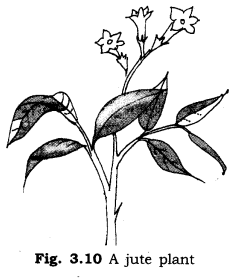
NCERT Solutions for Class 6 Science Chapter 3 Fibre to Fabric SAQ Q5

Q. 6. What are looms?
Ans. The devices on which weaving of fabrics takes place are called looms. The looms are either hand operated or power operated.

LONG ANSWER TYPE QUESTIONS

Q.1. Describe the process of the formation of yam from cotton wool.
Ans. The cotton wool is obtained from cotton plants. The cotton plants are grown in fields. They are usually grown at the places having black soil and warm climate. The fmits of the cotton plants called cotton bolls are about the size of lemons. After maturing, the bolls burst open and seeds covered with cotton fibres can b,e seen. From the cotton bolls cotton is picked by hands. Fibres are then separated from the seeds by combing. This process is called ginning of cotton. It is done by hand or by machines. These fibres are then converted into yam.
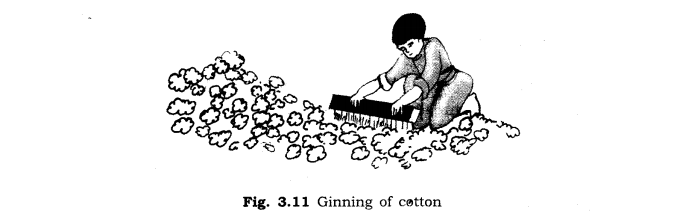
NCERT Solutions for Class 6 Science Chapter 3 Fibre to Fabric LAQ Q1
Q.2. Describe the process of spinning and weaving.
Ans. Spinning: The process of making yarn from fibres is called spinning. In this process fibres from a mass of cotton wool are drawn out and twisted. By this fibres come together to form a yarn. Spinning can be done by hand, by takli and charkha. On a large scale, spinning is done with the help of machines.
Weaving: The process of arranging two sets of yarns together t6 make a fabric is called weaving. The process of weaving can be done on looms. The looms are either-hand operated or power operated.

CLASS-8 SOCIAL SCIENCE HISTORY CHAPTER-8 INDIA AFTER INDEPENDENCE

 EVENTS CONVENT HIGH SCHOOL

05/01/2022      CLASS- 8   SESSION 2021-22
SUBJECT :SOCIAL STUDIES 

CHAPTER-8 HISTORY

INDIA  AFTER INDEPENDENCE
______________________________________


Question 1.Choose the correct option.
(i) Which one is not a feature of the Indian Constitution?
(a) It adopted the universal adult franchise
(b) It gave politicians special powers
(c) It provided equality before the law to all citizens
(d) It offered special privileges for the poorest and most disadvantaged Indians

(ii) Which one is the subject of the State List?
(a) Education
(b) Defence
(c) Forests
(d) Agriculture

(iii) Who is called the father of the Indian Constitution?
(a) Mahatma Gandhi
(b) Jawaharlal Nehru
(c) Vallabhbhai Patel
(d) Bhimrao Ambedkar

(iv) The bilingual state of Bombay was divided into separate states for
(a) Marathi and Telugu speakers
(b) Marathi and Malayalam speakers
(c) Marathi and Gujarati speakers
(d) Bengali and Gujarati speakers

(v) Who was the Deputy Prime Minister of Independent India?
(a) Motilal Nehru
(b) Bhim Rao Ambedkar
(c) Vallabhbhai Patel
(d) MaulanaAzad
Answer.
(i) (b), (ii) (a), (iii) (d), (iv) (d), (v) (c).

Question 2.Fill in the blanks with appropriate words to complete each sentence.

  1. Prime Minister Jawaharlal Nehru was also the ………….. minister of newly independent India.
  2. The Bhilai steel plant was set up with the help of the former …………. in 1959.
  3. In 1966, the state of Punjab was divided into ………… and ……………..
  4. India’s population in 1947 was almost …………… million.
  5. Soon after Independence, India chose to grant …………… right to all its citizens regardless of gender, class or education.

Answer.

  1. Foreign
  2. Uncivilised, civilised
  3. Punjab, Haryana
  4. 345
  5. Voting

Question 3.State whether each of the following statements is True or False.

  1. The Adivasis or the Scheduled Tribes were not granted reservation in seats and jobs.
  2. Dr. B.R. Ambedkar belonged to a Marathi-speaking Dalit family.
  3. Bridges and dams became the symbol of development in free India.
  4. Dharavi in Gujarat is one of the world’s largest slums.
  5. Nehru and Patel wanted to divide the country on the basis of language.

Answer.

  1. False
  2. True
  3. True
  4. False
  5. False

Question 4.
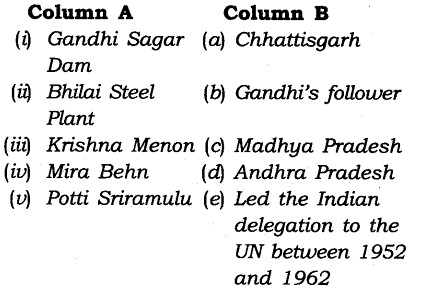
Match the items given in Column A correctly with those given in Column B.

NCERT Solutions For Class 8 History Social Science Chapter 12 India After Independence Exercise Questions Q4
Answer.
(i) (c), (ii) (a), (iii) (e), (iv) (b), (v) (d).

Very Short Answer Type Questions

Question 1.When was the Indian Constitution adopted?
Answer.
The Indian Constitution was adopted on 26 January 1950.

Question 2.Which step has been described as revolutionary?
Answer.
All Indians above the age of 21 would be allowed to vote in state and national elections.

Question 3On what point did Nathuram Godse disagree with Gandhiji?
Answer.
Nathuram Godse disagreed with Gandhiji’s conviction that Hindus and Muslims should live together in harmony.

Question 4.Name two subjects of the State List.
Answer.
Education and health.

Question 5.Name two subjects of the Concurrent List.
Answer.
Forests and agriculture.


Short Answer Type Questions

Question 1.What created problems in unifying the people of India after it got independence?
Answer.
The points that created problems were:

  1. At the time of independence, India’s population was large. It was divided too. There were divisions between high castes and low castes, between the majority Hindu community and Indians who practised other faiths.
  2. The citizen of this country spoke different languages, wore different kinds of dresses, ate different kinds of foods, and practiced different professions.

Question 2.What was the label of development of India at the time it got inde¬pendence?
Answer.
At the time India got independence the label of its development was very low. A vast majority of Indians lived in the villages. Farmers and peasants depended on the monsoon for their survival. So did the non-farm sector of the rural economy, for if the crops failed, barbers, carpenters, weavers, and other service groups would not get paid for their services either. In the cities too the condition was not good. Factory workers usually lived in crowded slums. They had little access to education and health care.

Question 3.What special privileges were offered for the poorest and most disadvantaged Indians by the constitution?
Answer.
First of all the practice of untouchability was abolished. Hindu temples were thrown open to all including the former untouchables.

  • A certain percentage of seats in legislatures as well as jobs in government were reserved for members of the lowest castes.

Long Answer Type Questions

Question 1.Give detailed descriptions of the features of the Indian Constitution.
Answer.

We have a written Constitution which was adopted on 26 January 1950.
Features:
(a) One feature of the Indian Constitution was that it adopted a universal adult franchise. All Indians above the age of 21 (now 18) would be allowed to vote in state and national elections.

(b) Our Constitution guaranteed equality before the law to all citizens, regardless of their caste or religious affiliation.

(c) The Constitution offered special privileges for the poorest and most disadvantaged Indians. The evil practice of untouchability was abolished. Hindu temples were thrown open to all, including the former untouchables. After a long debate, the Constituent Assembly also recommended that a certain percentage of seats in legislatures as well as jobs in government be reserved for members of the lowest castes, including the Adivasis.

Question 2.Give an account of the successes and failures of the country during the sixty-two years of its independence.
Answer.
Sixty-two years of independence have passed. This duration covers a long journey. A lot has been achieved during this time. But at the same time, there have been a number of failures.

Successes :

  1. India is still united and it is still democratic. These achievements definitely make us proud. Many foreign observers had felt that India could not survive as a single country. Others believed that it would come under military rule. Neither of these predictions proved to be true. As many as thirteen general elections have been held since independence, as well as hundreds of state and local elections.
  2. There is a free press and an independent judicially.
  3. The fact that people speak different languages or practice different faiths has not come in the way of national unity.

Failures:

  1. Deep divisions are still there. Despite constitutional guarantees, people belonging to the lowest castes, such as Dalits face violence and discrimination. In many parts of rural India, they are not allowed access to water sources, temples, parks, and other public places.
  2. The gulf between the rich and the poor has grown over the years. Some groups of people avail all facilities while many others continue to live below the poverty line.
  3. Our Constitution provides equality before the law but in real life, this does not happen. Some Indians are more equal than others.

class-9 subject social science chapter-4 Geograpgy CLIMATE

 EVENTS CONVENT HIGH SCHOOL

05/01/2022      CLASS- 9   SESSION 2021-22
SUBJECT :SOCIAL STUDIES 

CHAPTER-4 GEOGRAPHY

CLIMATE
______________________________________


1. Choose the correct answer from the four alternatives given below.

(i) Which one of the following places receives the highest rainfall in the world?

(a) Silchar

(b) Mawsynram

(c) Cherrapunji

(d) Guwahati

Ans:

(b) Mawsynram


(ii) The wind blowing in the northern plains in summers is known as:

(a) Kaal Baisakhi

(b) Loo

(c) TVade Winds

(d) None of the above

Ans:

(b) Loo


(iii) Which one of the following causes rainfall during winters in north-western part of India,

(a) Cyclonic depression

(b) Retreating monsoon

(c) Western disturbances

(d) Southwest monsoon

Ans:

(c) Western disturbances


(iv) Monsoon arrives in India approximately in:

(a) Early May

(b) Early July

(c) Early June

(d) Early August

Ans:

(c) Early June


(v) Which one of the following characterises the cold weather season in India?

(a) Warm days and warm nights

(b) Warm days and cold nights

(c) Cool days and cold nights

(d) Cold days and warm nights

Ans:

(c) Cool days and cold nights


2.Answer the following questions:-

Question-1What are the controls affecting the climate of India?

Solution:
There are six major controls of the climate of any place. They are:

  1. Latitude
  2. Altitude
  3. Pressure and wind system
  4. Distance from the sea (continentality)
  5. Ocean currents
  6. Relief features

Question-2Why does India have a monsoon type of climate?
Solution:
The monsoon type of climate is characterised by a distinct seasonal pattern. The weather conditions greatly change from one season to the other. These changes are particularly noticeable in the interior parts of the country. The coastal areas do not experience much variation in temperature though there is variation in rainfall patterns. Four main seasons can be identified in India – the cold-weather season, the hot weather season, the advancing monsoon, and the retreating monsoon with some regional variations.

Question-3Which winds account for rainfall along the Malabar Coast?
Solution:
Surface winds account for rainfall along the Malabar coast.

Question-4What are Jet streams and how do they affect the climate of India?
Solution:
Jet streams are a narrow belt of high altitude (above 12,000 m) westerly winds in the troposphere. Their speed varies from about 110 km/h in summer to about 184 km/h in winter. A number of separate jet streams have been identified. The most constant is the mid-latitude and the subtropical jet stream.

Over India, these jet streams blow south of the Himalayas, all through the year except in summer. The western cyclonic disturbances experienced in the north and northwestern parts of the country are brought in by this westerly flow. In summer, the subtropical westerly jet stream moves north of the Himalayas with the apparent movement of the sun. An easterly jet stream, called the tropical easterly jet stream blows over peninsular India, approximately over 14°N during the summer months.

Question-5Define monsoons. What do you understand by “breaks” in monsoon?
Solution:
The seasonal reversal in wind direction during a yeat is called the monsoon. Monsoon tends to have ‘breaks’ in rainfall; which means that there are wet and dry spells in between The monsoon rains take place only for a few days at a time and then come to the rainless intervals.

Question-6Why is the monsoon considered a unifying bond?
Solution:
Despite great moderating influences on the climate of India, there are great variations in the temperature conditions. Nevertheless, the unifying influence of the monsoon on the Indian subcontinent is quite perceptible. The seasonal alteration of the wind systems and the associated weather conditions provide a rhythmic cycle of seasons.

Question-7Why does the rainfall decrease from the east to the west in Northern India?
Solution:
The western coast and northeastern India receive over about 400 cm of rainfall annually. However, it is less than 60 cm in western Rajasthan and adjoining parts of Gujarat, Haryana, and Punjab. Rainfall is equally low in the interior of the Deccan plateau, and east of the Sahyadris. The third area of low precipitation is around Leh in Jammu and Kashmir. The rest of the country receives moderate rainfall.

Snowfall is restricted to the Himalayan region. Owing to the nature of monsoons, the annual rainfall is highly variable from year to year. Variability is high in the regions of low rainfall such as parts of Rajasthan, Gujarat and the leeward side of the Western Ghats. As such, while areas of high rainfall are liable to be affected by floods, areas of low rainfall are drought-prone.

Question-8Give reasons as to why.
(i) The bulk of rainfall in India is concentrated over a few months.
(ii) The Tamil Nadu coast receives winter rainfall.

Solution:
(i) The bulk of rainfall in India is concentrated over a few months
The inflow of the south-west monsoon into India brings about a total change in the weather. Early in the season, the windward side of the Western Ghats receives very heavy rainfall, more than 250 cm. The Deccan Plateau and parts of Madhya Pradesh also receive some amount of rain in spite of lying in the rain shadow area. The maximum rainfall of this season is received in the north-eastern part of the country. Mawsynram in the southern ranges of the Khasi Hills receives the highest average rainfall in the world. Rainfall in the Ganga valley decreases from the east to the west. Rajasthan and parts of Gujarat get scanty rainfall.

(ii) The Tamil Nadu coast receives winter rainfall
A characteristic feature of the cold weather season over the northern plains is the inflow of cyclonic disturbances from the west and the northwest. These low-pressure systems, originate over the Mediterranean Sea and western Asia and move into India, along with the westerly flow. They cause the much-needed winter rains over the plains and snowfall in the mountains. Although the total amount of winter rainfall locally known as ‘mahawat’ is small, they are of immense importance for the cultivation of ‘rabi’ crops. The peninsular region does not have a well-defined cold season. There is hardly any noticeable seasonal change in temperature patterns during winters due to the moderating influence of the sea.

Question-9Describe the regional variations in the climatic conditions of India with the help of suitable examples.
Solution:
Despite an overall unity in the general pattern, there are perceptible regional variations in climatic conditions within the country. The two important elements, which cause these variations, are – temperature and precipitation.
For example, in summer, the mercury occasionally touches 50°C in some parts of the Rajasthan desert, whereas it may be around 20°C in Pahalgam in Jammu and Kashmir. On a winter night, the temperature at Drass in Jammu and Kashmir may be as low as minus 45°C. Tiruvananthapuram, on the other hand, may have a temperature of 20°C.